
Bitter Chocolate, Realities – Rotten
In the last days, I got a homework from university which is watching an episode of a series. Opening and seeing that the episode is about bitter chocolate, it took my intention, so I decided watching and taking notes to write a blog.
There’s an episode in Rotten season 2. episode 5. named Bitter Chocolate. This episode is dedicated to show the process of bitter chocolate until it comes to markets. The aim of this series is showing the realities of the things we’ve adopted daily.
What I understood is that a bag of the chocolate faces very troublesome processes. The thing is these processes are not any nice!
Think about you’re working for a company and they pay you $1. Then, they use the the work you did, add just a bit of work on it, and sell for $1.000. Afterwards, the company buying it does just a bit more work on it, and sell for $100.000. What I got from this episode is the same. Let’s understand this perspective:
Bitter chocolate can grow in many locations, but will grow faster under some specific climates. The top of such climates are in Africa, more precisely in the cities Ghana and Ivory Coast of Africa. And this is what puts all eyes on them.
If you have this kind of good natural power, but don’t have politicial power, what do you think will happen? Of course, they’ll come, use you and your land, and make you quiet. What happens in Africa is this.
In this episode of the series, big problems of producing cocoa are emphasized. However, they don’t just do on documentaries, they bring the real actors. The people who worked in the companies that runs these, the people who know these processes, etc. For example, Henk Jan Beltman – Former CEO of Tony’s Chocolonely, or Neil Gordon – a cocoa entrepreneur.
There are really big problems in this sector. For example, slavery. It’s like population of Africa is working for the world like slaves. They work for the whole day, and earn $200 dollars per year, which is not even $1 a day!
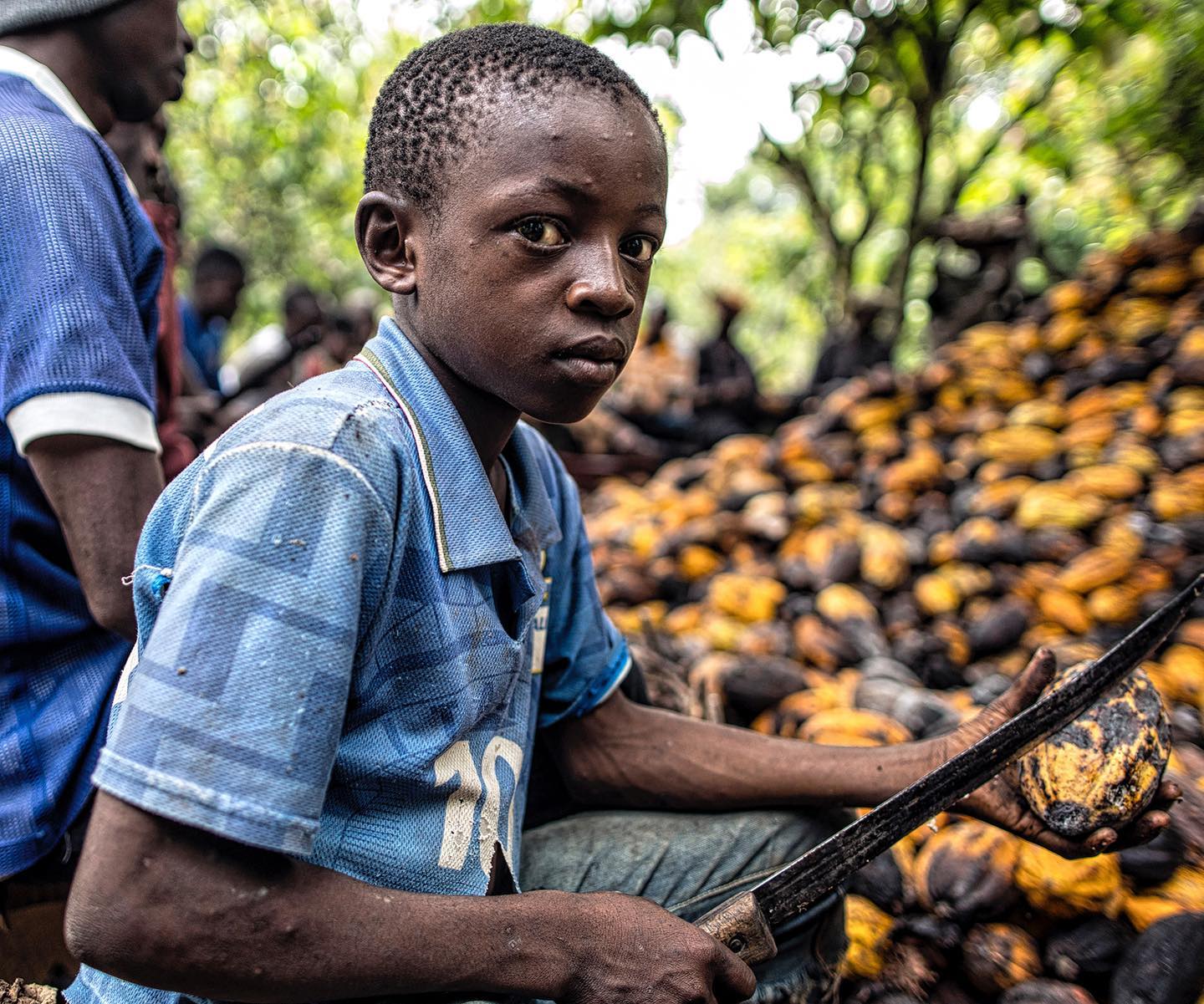
Another problem is child labor. Research shows that 43-45% of children, nearly 1.5 million are working illegally for cocoa.
A different problem is money distribution. If you remember, I gave an example. It happens here almost the same. What fermers are getting are on the ground, what the people who export, trade, sell, distribute are having big amounts.
There was a great example in the episode. The woman says, it’s like a hourglass. In one side of it is farmers, in the other is consumers. In the middle of the hourglass is handful of companies that run everything. Some examples are Barry Callebaut, Cargill, Olam, etc.
What they care about is only money. They control the money that goes to farmers, and the price for consumers. The thing is, they decide low amount for farmers, because they buy, and high amount for consumers, because they sell.
There was a guy in the movie, who was high in rank in one of these companies. He talks about how dirty these processes are, and how regretful he is for helping it to grow.
As I watched the movie, I saw what money is “capable of”. The inequality in the world is very sad.
Solution
If you ask, what’s the solution?
What I think the solutions are for this kind of things in the world, is heavy punishments. I mean, if a company does not provide what a farmer deserves, the company should be punished with something that it never can have it again. If a company owns $10, punishing it with $1 is meaningless. If it earned $10 illegally, it can earn another $10 after $1 punishment.
But if we punish it with something that it never will have it again, no other company will do it. The punishment is not just money.
Subscribe to get notified when new post is published!
